
The Evolution of Modern Windshields
Years ago, a windshield's primary job was simply to protect occupants from wind, dust, and road debris. Today it has become an essential structural and safety component of the vehicle. Modern windshields now contribute to:
Because of these additional responsibilities, even a small installation mistake can affect both safety and vehicle performance.
Why Are Modern Windshields Curved?
Curved windshields aren't just about making cars look stylish. Manufacturers design them to deliver several measurable advantages:
Better Aerodynamics
A curved design allows air to flow smoothly around the vehicle, reducing drag and improving fuel efficiency.
Improved Visibility
The larger curved glass provides a wider field of vision, helping minimise blind spots while driving.
Stronger Vehicle Structure
Modern windshields contribute significantly to the overall rigidity of the vehicle and cabin integrity during accidents.
Lower Wind Noise
The smooth curvature reduces turbulence, making the cabin noticeably quieter at highway speeds.
Why Curved Windshields Are Difficult to Handle
Although curved glass offers many benefits, it creates several challenges during auto windshield replacement. Unlike flat glass, curved windshields:
Handling challenges for curved glass
- Cannot be placed on flat surfaces without dedicated support
- Flex differently during lifting — creating uneven internal stress
- Require even pressure distribution while being carried
- Are more prone to cracking if lifted at the wrong angle
- Must align perfectly with the vehicle frame at millimetre precision
Even a slight twist while carrying the glass can introduce stress that leads to damage during installation. This is why experienced technicians rely on dedicated handling equipment rather than manual lifting.
Specialised Equipment Used During Windshield Replacement
Professional workshops invest in advanced tools that make installation safer and more accurate:
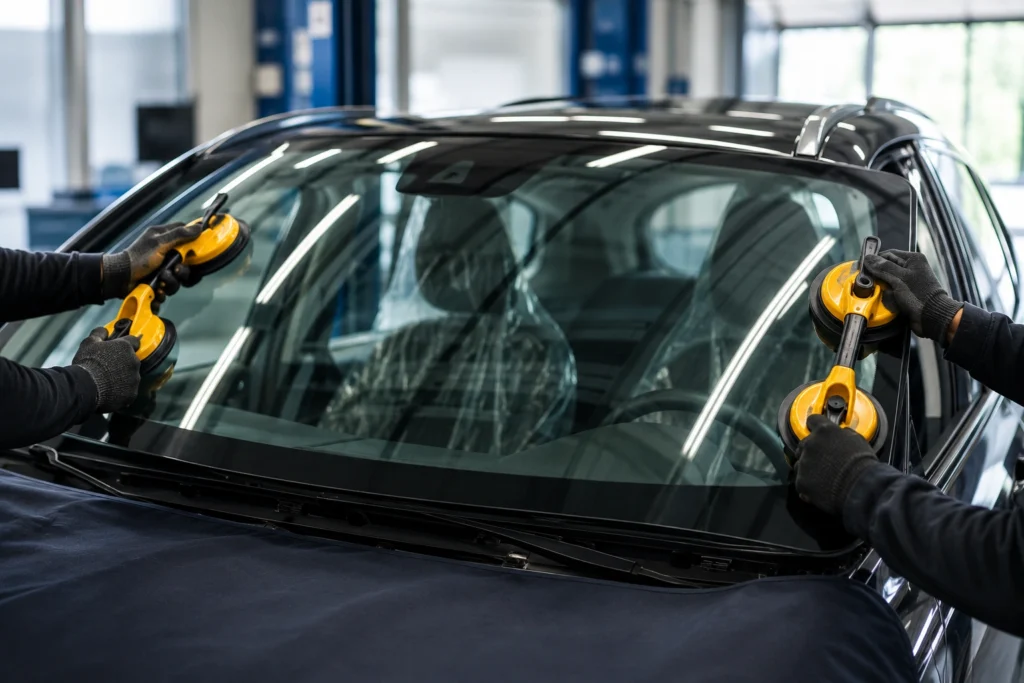
Heavy-Duty Vacuum Suction Lifters
Large industrial suction cups securely grip the glass without placing pressure on the fragile edges, allowing technicians to handle the windshield with full control.
- Lift the windshield safely without edge stress
- Position with millimetre-level accuracy
- Prevent stress fractures during placement
- Eliminate risk of accidental drops
Windshield Installation Stands
Before installation, the glass needs a secure resting position. Specialised stands protect the curved shape, prevent scratches, and keep the windshield stable while primers and adhesives are properly prepared.
Power Cutting Tools
Removing an old windshield without damaging the vehicle frame requires precision. Professional cutting systems remove existing adhesive evenly while protecting:
- Paint and body finish
- Dashboard and interior trim
- The critical pinch weld area
Precision Positioning Systems
Modern windshields need millimetre-level accuracy. Positioning tools ensure the glass sits exactly where the manufacturer intended — essential for perfect weather sealing and the correct operation of all camera-based safety systems.
OEM-Approved Adhesive Application Tools
The adhesive holding the windshield is part of the vehicle's structural safety. Calibrated dispensing equipment applies the correct bead size and thickness — ensuring proper bonding, water-tight sealing, correct airbag performance, and long-term structural integrity.
Why Manual Handling Is Risky
In many cases, the damage from improper installation isn't immediately visible — but becomes noticeable weeks later as leaks, noise, or safety system faults develop.
Modern Cars Have Sensitive Technology Behind the Windshield
Depending on the vehicle model, the windshield may support multiple integrated systems. Improper installation or optical distortion can reduce the accuracy of every one of these safety features — making professional recalibration essential after every replacement.
Why Professional Windshield Replacement Matters
A professionally installed windshield offers far more than a clean appearance:
- Maximum passenger safety and structural protection
- Proper airbag deployment during collisions
- Leak-free, water-tight installation
- Long-lasting adhesive bonding under all conditions
- Correct operation of all integrated safety technologies
- Better driving comfort and reduced wind noise
When Should You Get Your Windshield Inspected?
Can Insurance Cover Windshield Replacement?
Many comprehensive motor insurance policies include coverage for car windshield replacement under insurance. You may only need to pay the applicable deductible, depending on your insurer and policy terms:
Final Thoughts
Modern curved windshields are engineered to improve safety, comfort, and driving performance — but they also demand a higher standard of care during replacement. Using specialised handling equipment isn't simply about making the job easier. It's about protecting the glass, preserving your vehicle's structural integrity, and ensuring every integrated safety feature performs exactly as intended.
If your windshield has been damaged, don't trust it to just any repair shop. Choose experienced professionals equipped with the right tools to restore your vehicle safely and correctly.