
Why Is Proper Windshield Sealing So Important?
In most modern cars, the windshield is bonded to the body with automotive-grade polyurethane adhesive. When the installation is done correctly, that bond helps:
Even a small gap in the adhesive bead or an improperly prepared surface can weaken the seal — which is why every stage of car windshield replacement needs attention.
7 Professional Techniques That Make Windshield Installation Leak-Proof
A leak-proof installation begins before the new glass is fitted. Technicians remove the damaged windshield with specialised cutting tools, separating it from the body without damaging the surrounding frame, dashboard, or paintwork — and inspect the old adhesive and bonding area as they go.
Why it matters
If removal damages the metal frame or leaves uneven adhesive, the new windshield may not sit properly, creating weak bonding points and a higher chance of leaks.
The exposed frame — the pinch weld — is the metal surface around the windshield opening where the adhesive bonds the glass to the vehicle. Before fresh adhesive goes on, technicians check it for:
Remaining original polyurethane is generally trimmed per the adhesive manufacturer's instructions. If bare metal is exposed, the appropriate automotive primer or corrosion-protection procedure may be needed.
Why it matters
Skipping this step can compromise the bond even when a good-quality adhesive is used.
Unlike ordinary silicone sealants or household adhesives, automotive-grade polyurethane is designed to bond vehicle glass to the body structure. It provides the flexibility and strength to withstand:
Not every adhesive suits every vehicle — the correct one is chosen from the vehicle manufacturer's requirements and the adhesive maker's technical specifications. Substituting ordinary silicone for an automotive glass bonding system can compromise the installation.
Why it matters
The goal is not more adhesive. It is the correct adhesive, in the correct quantity, applied properly.
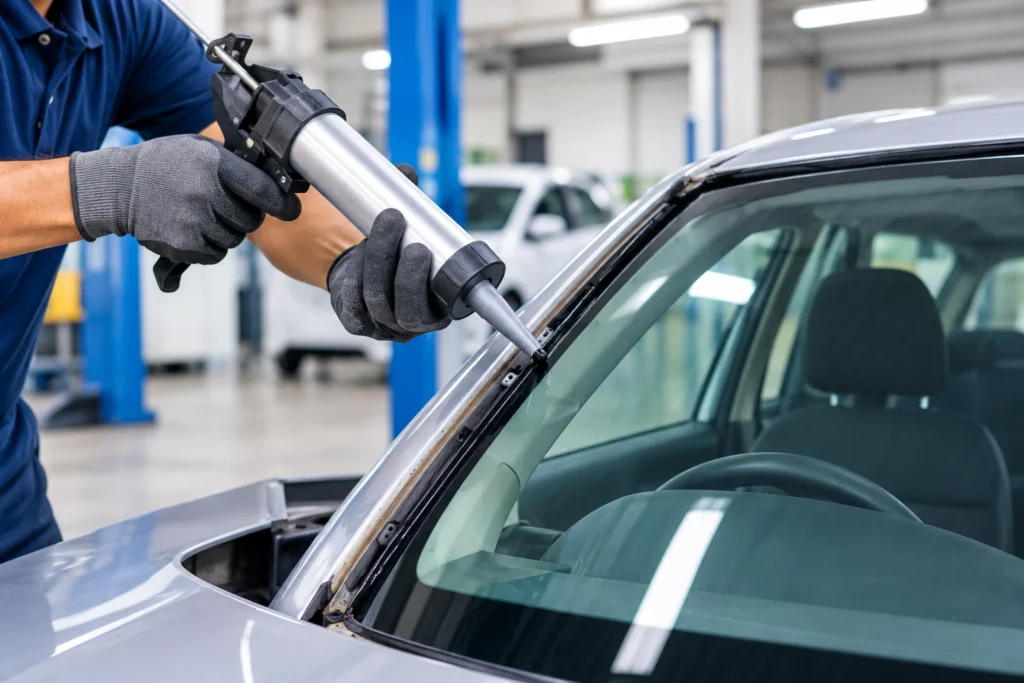
This is one of the most critical steps in preventing leaks. Technicians apply polyurethane around the bonding area with an applicator gun, usually as a continuous bead with a V-shaped or triangular profile, so the adhesive contacts both the prepared frame and the new glass.
Why it matters
More adhesive does not mean a stronger installation. A correctly applied, continuous bead matters far more than a larger quantity.
Even with perfect adhesive, poor positioning can ruin the seal. Technicians lift and place the new windshield using suitable glass-handling equipment such as suction-cup lifters, so it sits correctly in the opening. Proper positioning helps ensure:
- Consistent spacing around the windshield
- Correct contact between glass and adhesive
- Proper alignment with the vehicle body
- Correct placement of mouldings and trims
- Fewer gaps along the edges
Why it matters
A windshield set too high, too low, or unevenly may not touch the adhesive across the whole bonding surface. This is especially important for OEM glass replacement, where the glass must match the vehicle's original specifications.
A common mistake is assuming the car can be driven straight away. Polyurethane needs time to cure and build bonding strength. This is the Safe Drive-Away Time (SDAT) or Minimum Drive-Away Time (MDAT), depending on the adhesive system, and it varies with:
Driving before the recommended time can disturb the new bond and affect installation safety. Note also that the minimum safe drive-away time is not necessarily the same as complete curing — follow the manufacturer's curing instructions, and expect your technician to tell you the applicable time and precautions.
The job doesn't end when the glass is in place. A final inspection catches problems before the vehicle is handed back. Technicians should check:
- Whether the windshield is correctly aligned
- Whether the adhesive bead has proper contact
- Whether edges and corners are properly sealed
- Whether mouldings and trims are fitted correctly
- Whether there are any visible gaps or irregularities
Where appropriate, a controlled water test can reveal leaks around the perimeter. If water does enter, the source should be identified before any corrective sealing — a leak can also come from door seals, roof channels, sunroof drains, or body joints.
Common Mistakes That Cause Windshield Water Leakage
Even a new windshield can leak if certain steps are overlooked:
| Installation mistake | Possible consequence |
|---|---|
| Inadequate frame cleaning | Poor adhesive bonding |
| Incorrect adhesive selection | Weak or incompatible bonding |
| Gaps in the adhesive bead | Water and air leakage |
| Uneven adhesive application | Inconsistent glass contact |
| Improper windshield positioning | Gaps around the edges |
| Ignoring rust or paint damage | Long-term bonding problems |
| Driving before safe drive-away time | Disturbed adhesive bond |
| Incorrect moulding installation | Water entry or wind noise |
Don't try to fix every leak with silicone
Applying silicone around the visible edges is a common reaction to a windshield leak. In polyurethane-bonded windshield systems, a proper repair generally needs compatible polyurethane adhesive and an assessment of the existing installation. An external sealant may not address the underlying bonding problem.
How Can You Tell If Your Windshield Is Not Properly Sealed?
Signs often appear only after heavy rain or a car wash. Watch for:
Water dripping near the dashboard
Water near the dashboard or front pillars during rain may indicate a leak around the windshield or a nearby body joint.
Damp carpets
Moisture in the front footwell can be associated with windshield leakage, though other drainage and sealing issues should also be checked.
Whistling or wind noise
A poorly fitted windshield or a gap around its edges can let air in while driving.
Loose or uneven mouldings
Incorrectly fitted trims can indicate an installation issue and contribute to water or wind intrusion.
Visible gaps around the glass
Uneven spacing or noticeable gaps between the windshield and body deserve professional inspection.
If you notice any of these after car glass replacement, get the installation inspected rather than waiting for the leak to get worse.
Does Installation Quality Matter When You File an Insurance Claim?
Yes — insurance approval doesn't guarantee installation quality
Many Ahmedabad vehicle owners use insurance for windshield damage when their policy includes suitable glass coverage, and a cashless claim may be possible depending on the insurer, policy, vehicle eligibility, and service arrangement. But approval and cashless facilities don't automatically guarantee a good installation — it is equally important to choose a professional service that uses suitable glass, compatible adhesives, and correct fitting procedures.
Why Choose Professional Windshield Replacement in Ahmedabad?
Choosing the right service matters as much as choosing the right glass. Professional installation reduces the chances of recurring leaks, wind noise, and bonding problems. Star Glass House in Ahmedabad offers windshield and car glass replacement across passenger cars, luxury vehicles, and commercial vehicles, and assists with insurance-related requirements subject to the insurer's conditions and approval. When comparing providers, look for:
Also ask for clear guidance on adhesive curing and safe drive-away time. Whether you are searching for car windshield replacement near me or OEM glass replacement near me, don't decide on price alone — installation quality shapes long-term performance.
Final Thoughts
A leak-proof installation isn't achieved by smearing sealant around the glass and hoping for the best. It comes from proper removal, careful surface preparation, compatible polyurethane adhesive, accurate positioning, and enough curing time. A small mistake at any stage can mean leaks, wind noise, and weaker bonding.
If your windshield is cracked, damaged, or leaking after an earlier replacement, get it inspected by a professional. For reliable windshield replacement in Ahmedabad, connect with Star Glass House.